
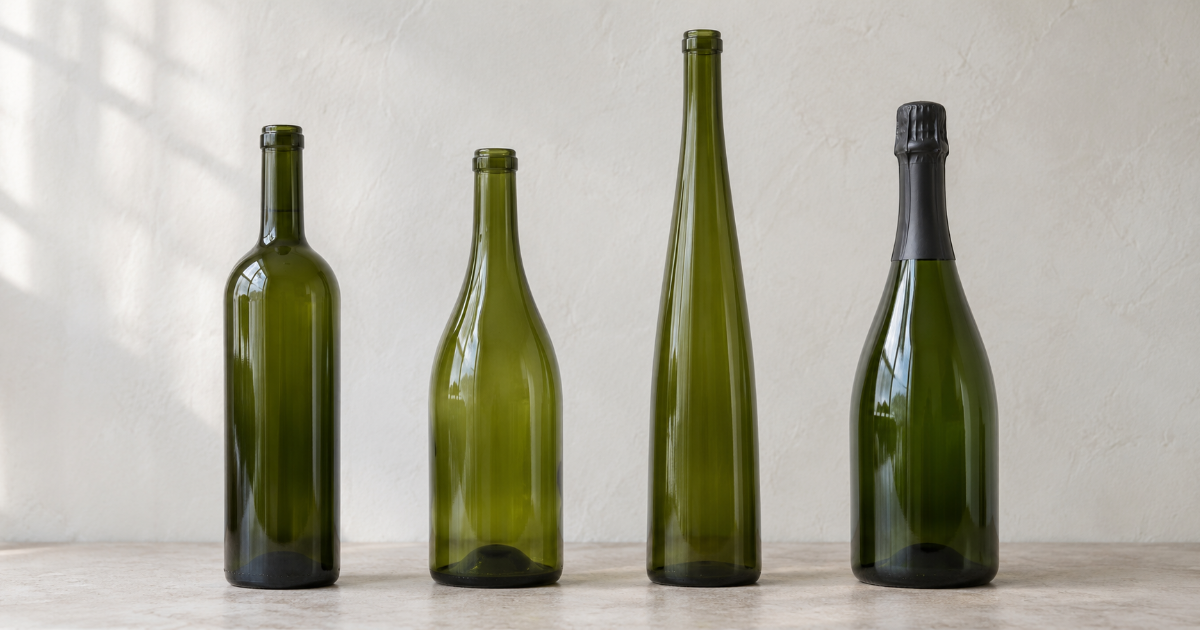
Because they were not all created in the same place, or for the same uses. Their silhouettes first emerged from regional glassmaking traditions. Some also meet technical requirements or appellation rules.
Each region began with its own traditions
Different ways of working and blowing glass gave rise to several bottle designs. These shapes were kept over time, becoming regional signatures: pronounced shoulders for the Bordeaux bottle, gentler curves for the Burgundy bottle, and a slender silhouette for the Alsace flute.
These designs then spread beyond their regions of origin. A bottle’s shape alone therefore cannot tell you where a wine comes from.
Tradition, rules or technical necessity?
| The bottle | What explains its shape |
|---|---|
|
The Bordeaux bottle |
A shape inherited from Bordeaux’s glassmaking tradition that became widely used. Its pronounced shoulders are a visual clue, not a guarantee of quality. |
|
The Burgundy bottle |
Another regional heritage, recognised by its gently sloping shoulders. This silhouette has also spread beyond Burgundy. |
|
The Alsace flute |
A regional identity that became a rule: AOC Alsace wines are presented in the ‘Rhine wine’ bottle type. |
|
The Champagne bottle |
A practical requirement: it must withstand the pressure of the gas. This explains its thicker glass and reinforced construction. |
Why not use one shape for everything?
Because the bottle also carries the wine’s identity. Keeping a familiar silhouette helps maintain a link with a region or tradition. And the needs differ: still wine and Champagne do not place the same demands on their containers.
The shape therefore tells a story, and sometimes reflects how the wine is made. When choosing what you enjoy drinking, the label and your wine merchant’s advice remain more useful than the silhouette alone.
 English
 繁體中文
 日本語
 한국어
 Français
 Português
 Español
 Italiano
 ไทย
 Tiếng Việt
