
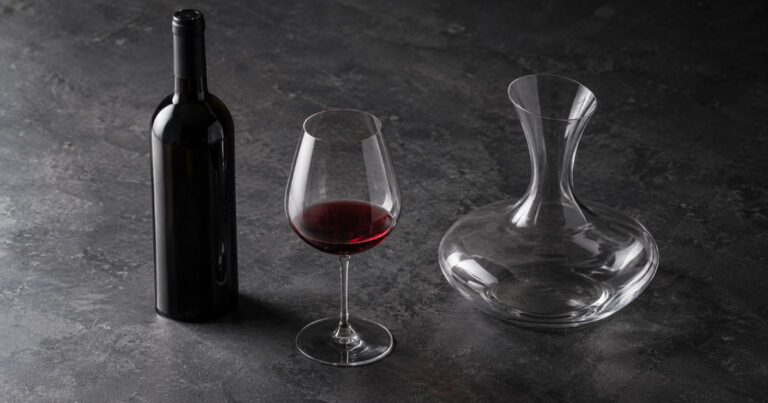
A decanter looks elegant on the table, but it is a tool rather than a ritual. Some wines become clearer and more expressive after contact with air. Others need gentle separation from sediment. A delicate bottle, however, can lose its balance if it is left in a broad decanter for too long.
The useful question is therefore not “Should red wine be decanted?” but “What does this particular bottle need today?”
Decanting and aerating are not quite the same thing
Strictly speaking, decanting means slowly transferring clear wine away from sediment. Aerating means increasing contact with oxygen so that aromas and texture can evolve. The same carafe can do both, but the goal changes the method.
young, compact wine
A usually needs air. A broad-based decanter creates more surface area.
mature wine with sediment
A needs precision. Pour slowly into a narrower vessel and stop before the deposit reaches the neck.
open and expressive
A wine that is already may need nothing more than a generous glass.
1. Structured reds: give them air—and keep tasting
Cabernet Sauvignon, Syrah, Tannat and similar structured reds can initially seem tight: the fruit is muted, the tannins dominate, or the aromas feel compressed. Air may help the wine become more expressive and integrated.
Taste the wine as soon as it is opened. If it feels closed, pour it into a clean decanter and taste again after 20 to 30 minutes. Continue checking it rather than relying on a universal timer. The right moment is when the aromas are clearer and the palate feels more harmonious—not simply when an hour has passed.
VAVIN bottle: Château de Ciffre Faugères Grand Vin Red 2019.
This high-altitude Faugères blends 50% Syrah, 40% Grenache and 10% Mourvèdre. Its black-fruit and spice profile, full palate and silky tannins make it a good candidate for measured aeration. Taste it first; if the bouquet still feels compact, begin with 30 to 45 minutes in a broad decanter, then check it again rather than leaving it unattended for hours.
2. A Southern Rhône blend: air without losing freshness
VAVIN bottle: Oratoire St-Martin Cairanne Réserve des Seigneurs Red 2021.
This Cairanne blends 40% Grenache Noir, 30% Mourvèdre, 20% Syrah, 5% Carignan and 5% Counoise. Plum and red-fruit aromas meet stony, earthy nuances, blond tobacco, pepper and liquorice over silky tannins. Pour a glass on opening. If the fruit remains restrained or the palate feels firm, give it 20 to 30 minutes in the decanter and taste again. The aim is to clarify the aromas and soften the structure—not to make the wine warmer or broader.
What about an older bottle with sediment?
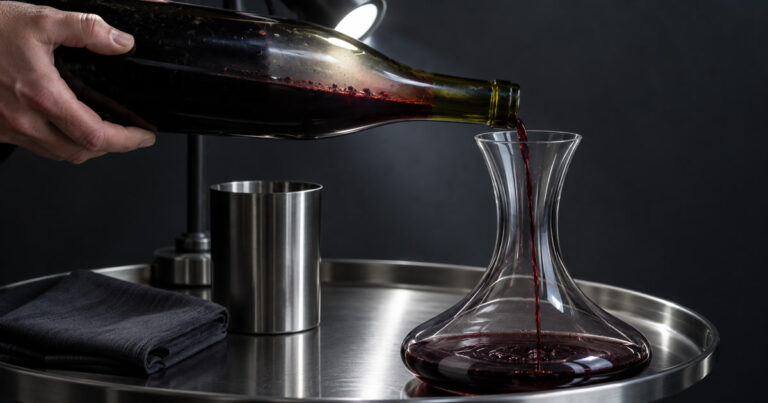
With an older wine, the objective is often the opposite. Bottle age can create a natural deposit, while the aromas may already be fully developed and more vulnerable to prolonged oxygen exposure.
Stand the bottle upright several hours before serving so the sediment can settle. Open it carefully, place a small light behind the shoulder of the bottle, then pour slowly and without interruption. Stop as soon as sediment approaches the neck. Taste promptly and avoid assuming that an old bottle needs hours of air. If it is already expressive, serve it rather than waiting for an arbitrary deadline.
3. Can white wine be decanted? Sometimes
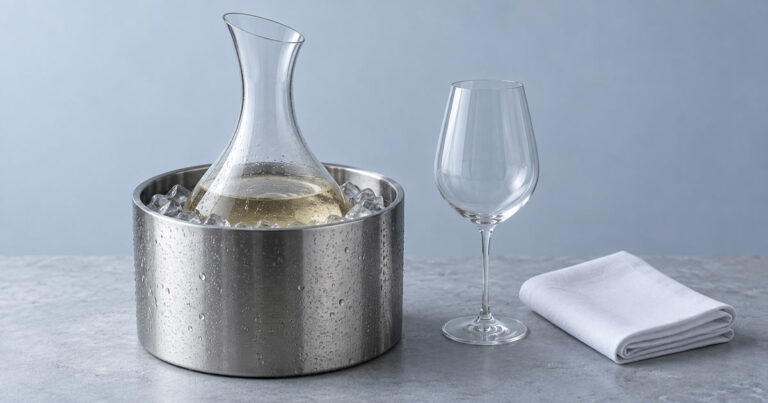
Colour is not the deciding factor. A young, concentrated or oak-influenced white can also benefit from brief aeration, especially if it seems muted or slightly reductive on opening. The risk is temperature: a white wine in a broad glass vessel can warm rapidly.
VAVIN bottle: Yves Cuilleron Saint-Joseph Lyseras 2023.
Made from 60% Marsanne and 40% Roussanne, Lyseras combines floral and stone-fruit aromas with roundness, minerality and freshness. Pour a small glass first. If it seems reserved, try a short 10-to-15-minute passage in a slim decanter, then taste again. Keep the carafe cool and return to service as soon as the wine opens.
In Taiwan, temperature is part of the decanting decision
A wide decanter does two things at once: it exposes wine to air and brings it towards room temperature. In Taiwan’s warmth, the second effect can happen faster than expected—even indoors.
Start a little cooler than the intended serving temperature. Keep the decanter away from sunlight, kitchen heat and warm table lamps. For white wine, or for a red that will remain in the carafe for a long time, use a stable wine cooler for short periods and check the wine regularly. A cooling sleeve or controlled wine chiller, including equipment from specialist brands such as VIVANT, can help maintain a more consistent temperature.
Do not chase an exact number at the expense of the wine. If aromas seem muted, allow it to warm slightly. If alcohol begins to dominate and the finish feels broad, cool it gently.
The quick decision guide
Young, structured red that tastes closed — Aeration
use a broad decanter; start with 20–30 minutes, then taste regularly.
Mature red with visible sediment — Separation
stand the bottle upright, pour slowly with a light and serve promptly.
Rich or concentrated white that seems muted — Brief aeration
use a slim decanter for 10–15 minutes, keep cool and taste again.
Delicate, fragrant or already expressive wine — Preservation
begin in a generous glass; decant only if the wine asks for it.
These are starting points, not fixed rules. Bottle variation, age, storage and serving conditions can all change the answer.
No decanter? No problem
A clean, odour-free jug can separate a mature wine from sediment. For a young wine, a large glass often provides enough air—pour a modest amount and swirl gently. Simply removing the cork hours in advance has a limited effect because only a small surface of wine is exposed in the bottle.
Whatever vessel you use, it must be impeccably clean and free from detergent or cupboard odours. Good service should make the wine clearer, not add another aroma.
The simplest rule: taste before, during and after
Decanting is not a performance and it is not mandatory. Open the bottle, pour a little, and decide from the glass. Young and compact? Give it air. Mature with sediment? Pour it gently. Already balanced and expressive? Enjoy it as it is.
Browse the VAVIN cellarAsk the VAVIN team on LINE
Product availability can change. Aeration times are practical starting points rather than absolute rules. Drink responsibly. Do not drink and drive. Alcohol is not for anyone under 18.
Editorial sources
- WSET — How to taste wine
- WSET — Wine Service Series
- Decanter — How to decant wine
- Decanter — Should you decant white wine?
- VAVIN product pages and internal catalogue; public-page status and availability checked on 7 October 2026.
 English
  繁體中文
繁體中文  日本語
日本語  한국어
한국어  Français
  Português
  Español
  Italiano
  ไทย
ไทย  Tiếng Việt