
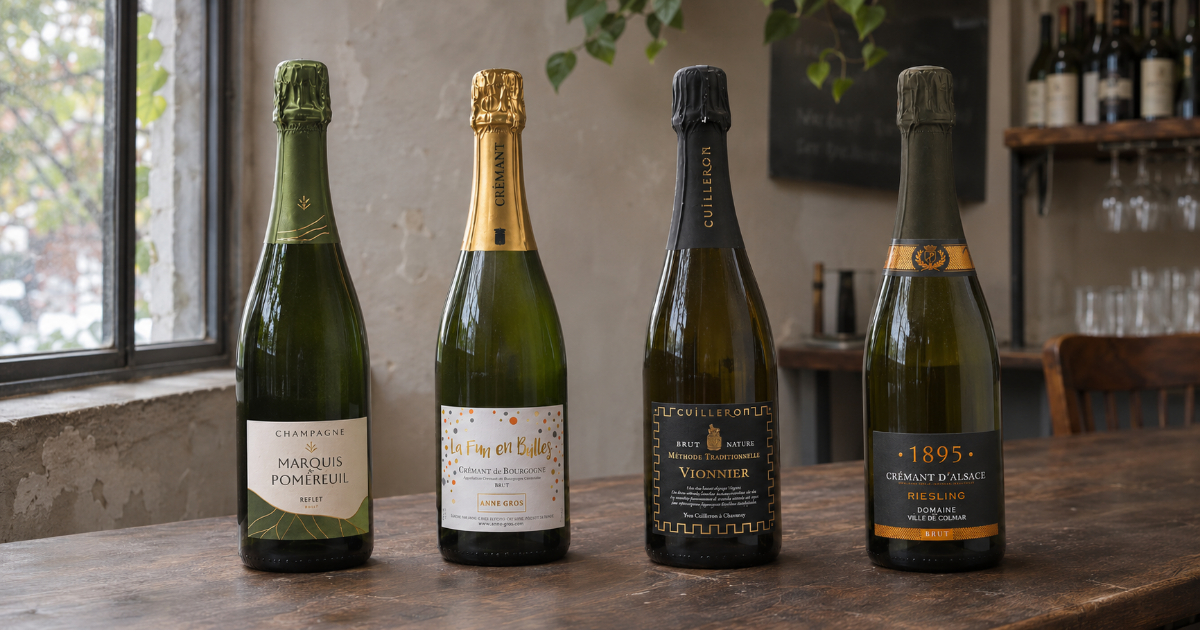
Bubbles in the glass, but different names on the labels… A few simple pointers are all you need to understand Champagne, Crémant and sparkling wine.
Sparkling wine: the whole family of bubbles
“Sparkling wine” simply means wine with bubbles. Champagne and Crémant belong to this family, alongside wines such as Italian Prosecco and Spanish Cava.
All Champagne is sparkling wine, but not all sparkling wine is Champagne!
Champagne and Crémant: a question of origin
The name Champagne is reserved for wines produced within the defined Champagne area, following the rules of its appellation. In our image, Marquis de Pomereuil Reflet Brut represents this origin.
Crémant wines have their own appellations. La Fun en Bulles by Anne Gros is a Crémant de Bourgogne, while Riesling Brut 1895 from Domaine de la Ville de Colmar is a Crémant d’Alsace. They belong to the same sparkling family, but their regions and grape varieties give them their own personalities.
How do the bubbles get into the wine?
During fermentation, yeast converts sugar into alcohol and produces carbon dioxide. Trapping this gas in a sealed container allows it to dissolve in the wine and emerge as bubbles when the bottle is opened.
Here are three ways this can happen:
- The traditional method: sugar and yeast are added to a still wine. A second fermentation takes place inside the sealed bottle. This is the method used for Champagne and Crémant.
- The tank method, also called Charmat: the second fermentation takes place in a large pressurised tank. The wine is then bottled while retaining its gas. This is how most Prosecco is made.
- The ancestral method: the wine is bottled before its first fermentation has finished. Fermentation continues in the bottle, trapping the gas inside.
“Sparkling wine” is the family; these methods are different ways of creating its bubbles.
The same method under other names
Vionnier by Yves Cuilleron, the fourth bottle in our selection, carries the words “Méthode Traditionnelle” without being Champagne or Crémant.
The method tells you how the wine is made; the appellation tells you about its origin and production rules.
Why don’t they all taste the same?
The method is only part of the story: grape varieties, climate, ageing and the final sweetness also shape the style. The traditional method alone does not guarantee that one wine will be better than another.
At VAVIN 酒盒子, these four bottles invite you to discover different expressions of sparkling wine, each with its own origin, craft and personality.
 English
 繁體中文
 日本語
 한국어
 Français
 Português
 Español
 Italiano
 ไทย
 Tiếng Việt
